
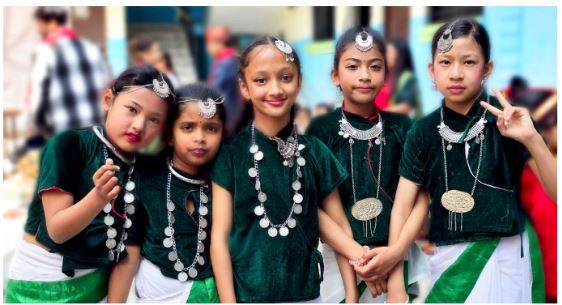
Grade 5
Grade 5 completes the Basic Level primary cycle at Himalaya College, an English medium school in Koteshwor, Kathmandu, building strong reading, maths and science foundations.
Duration
1 Academic Year
Completing the Basic Level
Grade 5 closes out the eight-year Basic Level cycle set out in the National Curriculum Framework, and at Himalaya College we treat it as a year of consolidation rather than a rush toward something new. Pupils arrive already familiar with the school's routines, and by the end of the year they are expected to read fluently, write in structured paragraphs, handle multi-step arithmetic, and speak confidently about the world around them. As an English medium school in Koteshwor, Kathmandu, we use English as the medium of instruction across most subjects while giving Nepali language and literature the depth it deserves.
Subjects Taught
- English
- Nepali
- Mathematics
- Science
- Social Studies
- Health, Population and Environment
- Computer Education
- Moral Education
- Physical Education
Each subject is taught by a teacher who specialises in that area rather than a single generalist covering the whole timetable, which matters more at this stage than parents sometimes expect. The gap between a pupil who is ready for Lower Secondary work and one who still needs support usually opens up right here.
What Pupils Are Expected to Master
By the end of Grade 5, a child should be comfortable with fractions and decimals, basic geometry, and word problems that require more than one operation to solve. In Science, the class moves from simple observation to early experimentation, recording what happens rather than being told what to expect. Social Studies widens out from the neighbourhood to Nepal's geography, history, and civic life, while Health, Population and Environment builds practical habits around hygiene, nutrition, and safety. Computer Education at this level covers keyboard skills, basic file handling, and an introduction to how software is organised, not simply games dressed up as lessons.
Classroom Practice
Teachers rely on group work, short projects, and regular oral practice alongside textbook study. A pupil who struggles with written expression but explains ideas well out loud is not written off; that gap is worked on directly. Homework is set with a purpose, usually to practise a specific skill rather than to fill an evening, and class sizes are kept small enough that a teacher can actually notice who has understood a concept and who is only nodding along. Reading is treated as a daily habit rather than a once-a-week activity, with pupils moving between guided reading in class and independent reading at home, and teachers checking comprehension through short discussions rather than tests alone.
English and Nepali Language Skills
Grade 5 marks the point where English writing is expected to move beyond simple sentences into short compositions with a clear beginning, middle, and end. Grammar is taught in context, through the pupil's own writing, rather than as an isolated set of rules to memorise. Nepali runs alongside this with equal weight given to reading comprehension, grammar, and creative writing, since a pupil weak in Nepali at this stage often struggles with Social Studies and Moral Education too, where much of the classroom discussion happens in Nepali. Spoken confidence in both languages is encouraged through short presentations, recitation, and classroom debate suited to the age group.
Assessment
Grade 5 assessment follows the Continuous and Comprehensive Evaluation approach recommended by the Curriculum Development Centre, combining classroom observation, periodic tests, and project work rather than relying on a single terminal exam. Progress is reported using letter grading, with descriptive feedback that tells parents what their child can already do and what still needs attention. This record becomes the starting point for Grade 6, so accuracy matters more than flattering marks.
Families researching Grade 5 admission in Kathmandu often ask what changes once Lower Secondary begins. The honest answer is that the habits built in Grade 5, reading for meaning, checking one's own arithmetic, asking a question instead of guessing, carry directly into the heavier subject load that follows. That is why this year gets treated with real seriousness at Himalaya College rather than as a formality before the "real school" starts. A pupil who leaves Grade 5 organised and curious is already halfway ready for what Lower Secondary will ask of them.
Message from the Principal
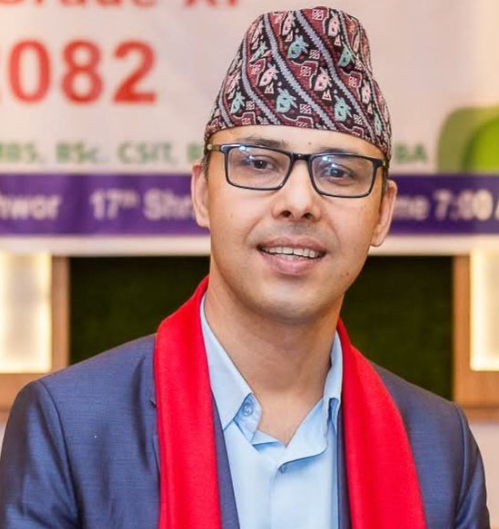
Hari Prasad Pant
Coordinator - School
As Coordinator - School at Himalaya College in Koteshwor, Kathmandu, the work is about supporting students, parents and colleagues. Coordination work keeps timetables, teaching, notices and student support organised, so that learners can concentrate on their studies. Students and parents are welcome to approach the coordination office with questions about classes, notices and academic guidance.
For School students and parents this means clear information about classes, notices and the support available. Information about admissions, notices and procedures is shared openly, and questions are always welcome. Working closely with teachers and the administration helps keep the day-to-day life of the college running smoothly for students. We look forward to welcoming you to Himalaya College and helping wherever we can.
Interested in Grade 5?
Fill out this form and our admissions team will guide you through the process.
First, which level are you interested in?
Other School Programs
Nursery
Nursery at Himalaya College welcomes three-year-olds into a warm, play-based classroom in Koteshwor, Kathmandu, building early language, motor and social skills through guided play.
LKG
LKG at Himalaya College builds on early play with structured pre-literacy and pre-numeracy activities, guiding four-year-olds in Koteshwor, Kathmandu toward confident classroom habits.
UKG
UKG at Himalaya College prepares five-year-olds for Grade 1 with structured literacy, numeracy and classroom-readiness skills at our school in Koteshwor, Kathmandu.
Grade 1
Grade 1 at Himalaya College marks the start of NEB Basic Level, English medium schooling, with structured subjects, daily practice and Continuous and Comprehensive Evaluation.
Grade 2
Grade 2 at Himalaya College strengthens core NEB subjects for seven-year-olds, building reading fluency, applied maths and science skills at our school in Koteshwor, Kathmandu.
Grade 3
Grade 3 at Himalaya College sharpens core NEB subjects and independent study habits for eight-year-olds at our English medium school in Koteshwor, Kathmandu.