
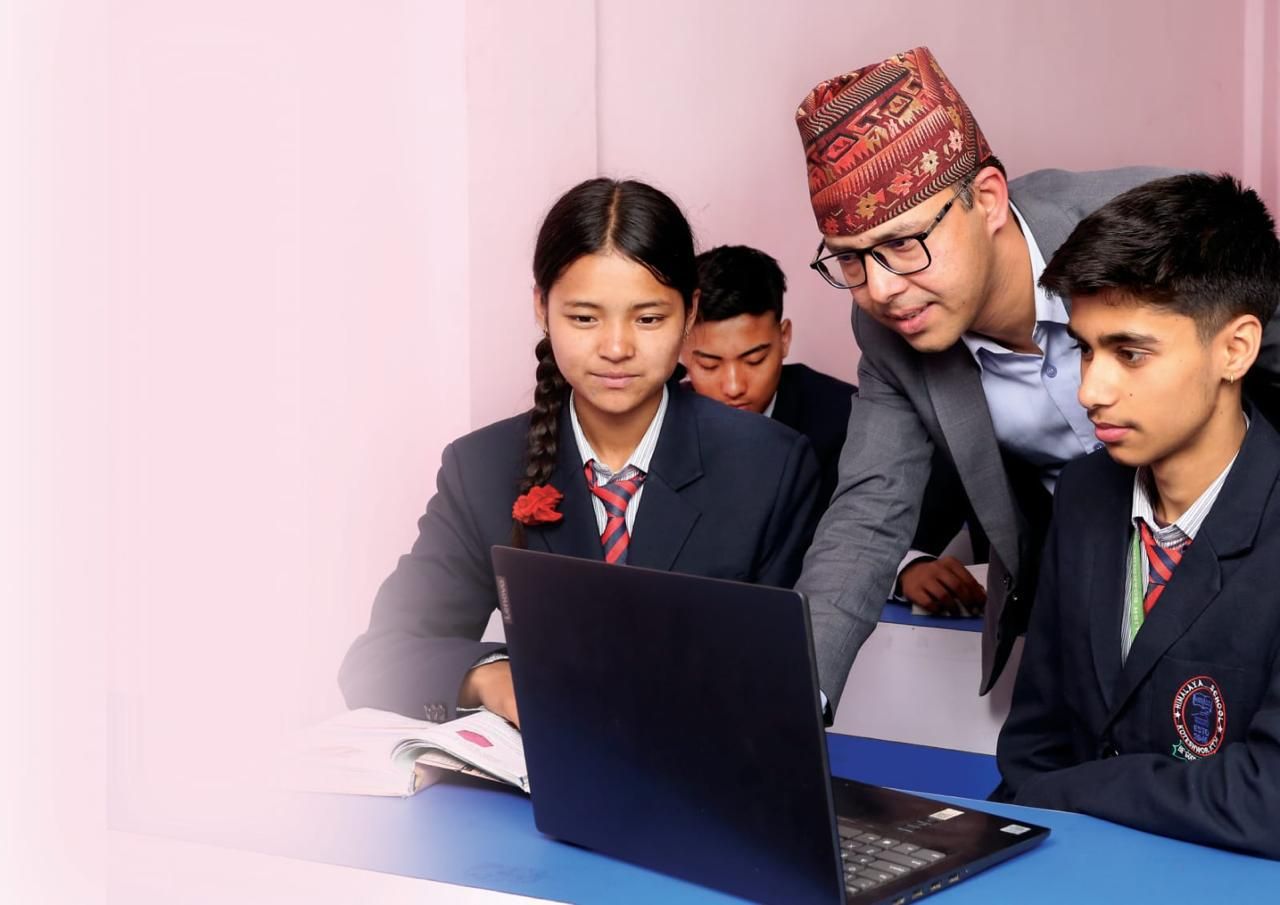
Grade 9
Grade 9 at Himalaya College builds the study habits and subject foundation students need before the SEE exam year, with English-medium instruction in Koteshwor.
Duration
1 Academic Year
Curriculum and Approach
Grade 9 opens the two-year Secondary Level cycle at Himalaya College, the stage of schooling set by Nepal's National Examinations Board that ends with the SEE exam at the close of Grade 10. For families weighing Grade 9 admission in Koteshwor, this is the year that quietly decides how a student handles the pressure of the SEE year that follows. We do not treat it as a warm-up. Subjects deepen noticeably from Grade 8, workloads increase, and students are expected to start managing their own revision schedules rather than being walked through every step.
Students moving up from Grade 8 usually need a few weeks to adjust to the pace of secondary-level work, and our teachers plan around that reality instead of ignoring it. Early in the year, instruction leans on guided practice and worked examples. As the months pass, we shift more responsibility onto students, asking them to attempt problems independently before a concept is explained in full. As an English medium school in Koteshwor, we run instruction in English across most subjects while still giving Nepali the depth it deserves as a compulsory subject with its own grammar, literature, and composition demands.
Compulsory Subjects
Every Grade 9 student at Himalaya College studies the same set of subjects laid out under the NEB Secondary Level curriculum. These form the backbone of the SEE syllabus and are not optional for any stream:
- English
- Nepali
- Mathematics
- Science
- Social Studies
- Health, Population and Environment / Physical Education
Mathematics and Science receive particular attention in Grade 9 because the concepts introduced here (algebraic manipulation, coordinate geometry basics, chemical reactions, biological classification) are the ones SEE questions build on directly in Grade 10. Social Studies and Health, Population and Environment round out a student's understanding of civic life, geography, and personal wellbeing, subjects the NEB expects every secondary student to carry forward regardless of which elective or future stream they choose.
Elective Subjects
Alongside the compulsory subjects, every Grade 9 student at Himalaya College chooses one elective. We keep this list focused on four academic subjects, each one chosen because it maps directly onto a specific +2 stream a student is likely to pursue:
- Account (Accountancy): covers bookkeeping and financial statement fundamentals, suited to students planning a Management +2 stream.
- Computer Science: builds programming fundamentals and digital literacy, useful across Science, Management, and general computing interests.
- Economics: introduces micro and macro concepts alongside the structure of the Nepali economy, relevant for Management and Humanities students.
- Optional Mathematics: extends into advanced algebra, trigonometry, and coordinate geometry, aimed at students headed toward Science or Management.
We do not offer any CTEVT-affiliated technical or vocational elective. That is a deliberate choice: it lets us put full teaching resources behind these four subjects and prepare students precisely for the +2 stream (Science, Management, Humanities, or Law) they are already aiming at, rather than spreading attention across a wider menu.
Learning Focus and Outcomes
By the end of Grade 9, a student should be reading NEB-style questions with less hesitation, showing full working in Mathematics and Optional Mathematics rather than jumping to answers, and writing structured English and Nepali compositions instead of short, disconnected paragraphs. Science lab work moves from observation to basic experimentation, and Social Studies assignments start asking for analysis, not just recall. These are not abstract goals; they are the specific habits that make Grade 10 SEE preparation manageable rather than overwhelming.
Teaching Methodology
Classroom teaching combines direct instruction with regular problem sets, group discussion, and periodic lab or project work depending on the subject. Teachers use past NEB question patterns to shape classroom exercises so that the format of SEE-style questions feels familiar well before Grade 10 arrives. Homework is checked and returned with written feedback rather than a simple mark, and subject teachers flag weak areas early so a student is not carrying an unresolved gap into the following year.
Assessment
Grade 9 students sit periodic class tests, terminal examinations, and a final annual examination, all set in the NEB format used for SEE preparation in Kathmandu schools. Results are shared with parents along with teacher remarks on specific subjects, so families can see where a student stands well before the stakes rise in Grade 10.
Message from the Principal

Hari Prasad Pant
Coordinator - School
As Coordinator - School at Himalaya College in Koteshwor, Kathmandu, the work is about supporting students, parents and colleagues. Coordination work keeps timetables, teaching, notices and student support organised, so that learners can concentrate on their studies. Students and parents are welcome to approach the coordination office with questions about classes, notices and academic guidance.
For School students and parents this means clear information about classes, notices and the support available. Information about admissions, notices and procedures is shared openly, and questions are always welcome. Working closely with teachers and the administration helps keep the day-to-day life of the college running smoothly for students. We look forward to welcoming you to Himalaya College and helping wherever we can.
Interested in Grade 9?
Fill out this form and our admissions team will guide you through the process.
First, which level are you interested in?
Other School Programs
Nursery
Nursery at Himalaya College welcomes three-year-olds into a warm, play-based classroom in Koteshwor, Kathmandu, building early language, motor and social skills through guided play.
LKG
LKG at Himalaya College builds on early play with structured pre-literacy and pre-numeracy activities, guiding four-year-olds in Koteshwor, Kathmandu toward confident classroom habits.
UKG
UKG at Himalaya College prepares five-year-olds for Grade 1 with structured literacy, numeracy and classroom-readiness skills at our school in Koteshwor, Kathmandu.
Grade 1
Grade 1 at Himalaya College marks the start of NEB Basic Level, English medium schooling, with structured subjects, daily practice and Continuous and Comprehensive Evaluation.
Grade 2
Grade 2 at Himalaya College strengthens core NEB subjects for seven-year-olds, building reading fluency, applied maths and science skills at our school in Koteshwor, Kathmandu.
Grade 3
Grade 3 at Himalaya College sharpens core NEB subjects and independent study habits for eight-year-olds at our English medium school in Koteshwor, Kathmandu.